
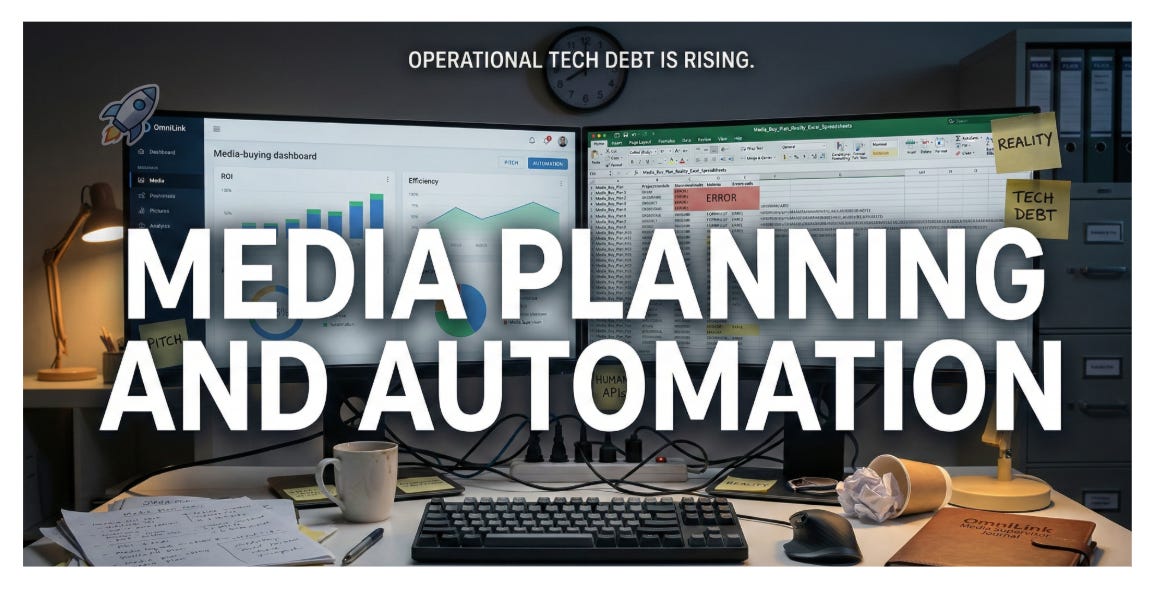
It’s 8:30 PM on a Tuesday. Do you know where your Media Supervisor is?
They aren’t brainstorming the next award-winning media strategy. They are likely jamming on a spreadsheet, manually reconciling rows 4,000 through 6,000 for a client deck that was due hours ago and the dashboard refresh failed again.
In the pitch room, however, these efforts are given a makeover. We push our teams to the limit to meet ultra-compressed deadlines, and then position the resulting speed as proof of efficiency and digital acceleration.
But that real-time optimization is often just human endurance, enabled by staff on the brink of burnout.
There is a disconnect between the promise we make in the pitch and the actual price. Speed is being sold as a native feature of our technology, but in reality, it is being paid for by human exhaustion.
This is often a blind spot for executive leadership who aren’t close enough to the work to feel it themselves. They see deadlines being met and margins holding, but they miss the hidden debt accumulating in the agency ranks.
This is Operational Tech Debt. It is the widening gap between the promise of automated efficiency and the manual labor actually required to deliver it. It is a Complexity Crisis where teams are drowning in noise and 60% of professional time is spent on coordination and administrative overhead instead of the skilled work they were hired to do.
The High Cost of Human Glue
Operational Tech Debt creates a kind of illusion that is hard to see at first. To the client and the C-suite, the deliverables are shipping. The plan looks polished. The buy is executed. But hidden beneath the surface is a chaotic web of manual workarounds used to meet compressed timelines.
We are essentially using our most promising talent as human APIs, as manual connectors bridging the gaps between ad platforms, billing systems, and reporting dashboards.
The debt is in the details. It’s the Media Planner staying up until midnight to fix taxonomy errors because the naming convention wasn’t standardized. It’s the Supervisor manually QA’ing thousands of placement rows because the plan vs actual report isn’t tying out after a last-minute channel reallocation.
In this environment, the spreadsheet becomes a danger zone. We export hundreds of millions of dollars in media plans into unstructured, error-prone sheets, relying on flimsy formulas to manage investments that require precision. We treat Google Sheets like a glorified, communal calculator, utilizing it for storage and simple math, while ignoring its capacity to run automated, deterministic workflows.
The Bill is Coming Due
For years, we have hidden these costs willfully. We fear admitting that our operations aren’t as streamlined as our pitch decks suggest. But the interest on this debt is compounding, and we are paying for it with two things we can’t afford to lose: data integrity and talent.
The Business Cost: What is the actual cost of a taxonomy error that creates unrecoverable data gaps? How much margin is eroded when it takes 48 hours to re-traffic a campaign that should have taken 48 minutes?
The Human Cost: We need our experienced people looking ahead, seizing opportunities, and innovating. Instead, the average knowledge worker is losing 209 hours a year to duplicative work and over 100 hours to unnecessary meetings. They are stuck in the weeds, scrambling to triage today’s deadline. You cannot retain top-tier talent if their primary job function is chasing and fixing data.
Automating for People
We must stop the charade of streamlined operations while churning through staff, and admit that we need a more intelligent design.
Solving Operational Tech Debt requires a pivot in how we view agency technology. We cannot solve this by simply buying more end-to-end macro-operating systems that promise to do everything yet excel at nothing. We must start solving the human problem first.
We must adopt a strategy of Automation with Intent. This requires a strict division of labor:
Automate the Repetitive: Assign the machine tasks requiring efficiency, scale, calculation, and precision.
Elevate the Human: Free the talent to focus on nuance, context, empathy, and strategy.
Focus on the media team’s daily workflows: Development should focus on task-specific tools that assist the Buyer and Planner. We don’t need more dashboards; we need deterministic workflows that can scan 20,000 rows of taxonomy for logic errors in seconds, and auto-generate cryptographic IDs for every placement to ensure data integrity. Give people tools that catch errors and create shortcuts within the environments they already use.
Let Practitioners Lead Redesign: Stop leaving workflow design to software engineers who have never trafficked a campaign. The people doing the work, the Supe and the Planner, are the only ones who know where the friction lives.
Prioritize Taxonomy as Infrastructure: One of the greatest sources of operational tech debt is naming convention errors (Campaign, Placement, Creative). If we standardize and automate taxonomy, we eliminate the vast majority of manual reconciliation and missing data.
Teams need budget approval gates with detailed logging, scripts that create Google Drive folder structures based on defined rules, and functions that can rename 300 creative files automatically. This is where Apollo Custom Tools solutions live.
What’s Next
Too many executives focus on the flashy new analytics model they can tout in a new business pitch, even if it’s untested, when the real gain is to fix the existing operating system. We can’t buy those solutions off the rack; we must build them.
The Path Forward: Automation Pathways
At Apollo Partners, we use our Automation Pathways framework to help clients identify exactly where to deploy their human talent and where to lean on automation, turning the promise of efficiency into a measurable reality.
We center our efforts on making a proactive decision on where our people add the most value, and then engineering the system to support that focus.
Define the Human Role: We start by explicitly designating the high-value zones such as strategy, empathy, and context, where we need our humans to focus.
Identify the Automation Opportunity: Once the human role is defined, we can clearly see the repetitive, manual tasks (scale, logic, calculation) that are currently blocking that focus.
Close the Gap: By visualizing the distance between our current reality and that intended state, we can prioritize the specific engineering projects that remove the friction.
This framework moves us toward a tactical roadmap. It allows us to systematically strip away the low-value repetition that leads to burnout, re-allocating human capacity back to value creation.
That takes commitment and expertise. But by expanding our focus to how we work, we can finally make the media team as sophisticated as the pitch theater promises it to be.
apollo custom tools ✦ | 2026